Marketing Teams: Funnel.io Alternatives That Rank Actions
Marketing teams: compare Funnel.io alternatives by architecture, migration cost, and action. Choose a pipe, a transformation engine, or Paid Lens.

Marketing Teams: Funnel.io Alternatives That Rank Actions
For most performance marketing teams, this platform is a Funnel.io alternative designed for decision-grade attribution and ranked action recommendations, not just data movement. If you only need to pipe ad data into a spreadsheet or BI tool, Supermetrics or Coupler.io will do the job for less money. Enterprises with governance requirements should look at Adverity or Domo. Keep Funnel.io if your team already relies heavily on its built-in transformation layer and switching costs outweigh the savings.
TL;DR:
- Performance marketing teams seeking actionable recommendations should consider Paid Lens, which ranks suggested changes based on expected business impact, rather than just providing raw data.
- For teams that need to transfer data into spreadsheets or BI tools without transformation, Coupler.io and Supermetrics offer lower-cost, pipe-only solutions that require manual normalization.
- Enterprises requiring governance, complex transformations, and control should evaluate Adverity or Domo, which provide managed ETL and custom data application capabilities.
- Migration costs will likely include significant work on field mapping, report rebuilding, and maintaining historical data, especially when switching from native transformation platforms to pipe-only tools.
- Conduct a comprehensive 30-day pilot by validating data totals, testing custom metrics, and ensuring data isolation, before committing to any platform switch.
Table of Contents
- What Are the Best Funnel.io Alternatives Right Now?
- Feature-by-Feature Comparison for Marketing Data Platforms
- How Do You Choose the Right Funnel.io Replacement?
- What Does Migrating Off Funnel.io Actually Cost?
- Customer Support and Service Quality Comparisons
- Scalability and Performance Under Different Usage Volumes
- Security and Compliance Features
- User Reviews and Case Studies for Real-World Effectiveness
- What I’d Actually Tell a Marketing Team Switching Platforms
- Try Paid Lens as Your Next Funnel.io Alternative
- Sources
- FAQ
What Are the Best Funnel.io Alternatives Right Now?
The market splits into four distinct categories, and confusing them is the single biggest mistake teams make when evaluating Funnel.io alternatives. Some tools only extract and load data (pipe-only). Others transform and normalize it the way Funnel.io does natively. A third group is built for agency reporting rather than raw data access. A fourth is enterprise-grade managed platforms with governance built in. Paid Lens sits in a fifth lane entirely: it doesn’t just move or display data, it ranks what to do next based on expected business impact.
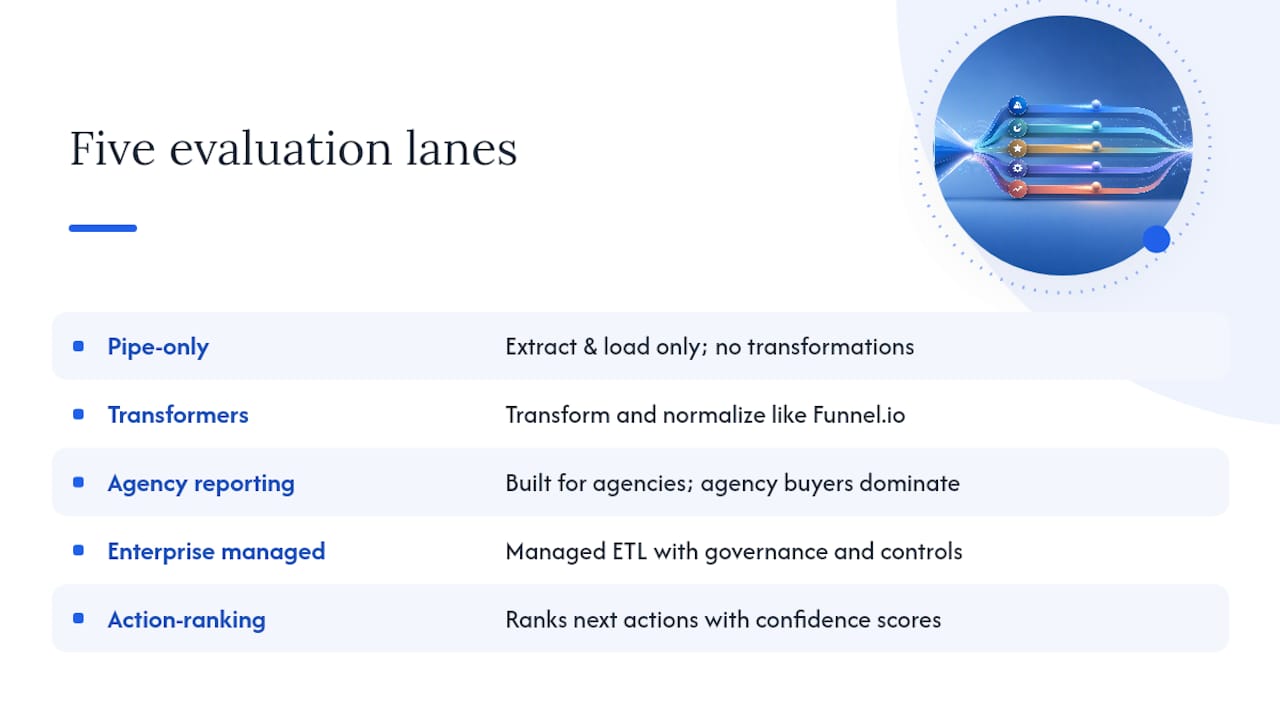
Semrush places Supermetrics and Coupler.io among the closest competitors to Funnel.io by traffic and market overlap, which tracks with what most procurement teams find when they start shopping. Whatagraph’s 2026 roundup adds Porter Metrics, Domo, Adverity, and NinjaCat to that shortlist, with agencies as the dominant buyer persona.
Here’s the shortlist, in the order most teams should actually evaluate them.
Paid Lens connects your ad platforms, validates data quality, and returns a ranked queue of recommended actions with confidence scores instead of a raw dashboard. It’s built for performance marketing teams who are tired of staring at charts and want to know what to change today. The tradeoff: it’s not a general-purpose BI pipe, so if your finance team wants raw exports into a warehouse for unrelated reporting, you’ll pair it with a connector tool rather than replace one.
Supermetrics pushes marketing platform data into Google Sheets, Looker Studio, and BigQuery with connectors that most analysts already know. It’s the default pick for teams that live in spreadsheets. G2 reviewers consistently praise the setup speed but flag per-destination pricing that climbs fast once you add more data sources and more output locations. There’s no meaningful transformation layer, so normalization work lands on your analysts.
Adverity is a managed ETL and governance platform aimed at enterprises that need transformations, access controls, and audit trails across dozens of data sources. It replicates more of what Funnel.io does natively than most alternatives on this list, which is exactly why it costs more and takes longer to onboard.
Domo is a full enterprise data platform: broad connectors, custom data apps, and dashboarding, built for organizations that want to build proprietary internal tools on top of their marketing data. It’s overkill for a five-person marketing team and appropriately scaled for a 500-person one.
Coupler.io is the budget pick. It’s a no-code connector for scheduled imports into spreadsheets, Excel, and BigQuery, with a lower starting price than most of this list. It’s pipe-only, so don’t expect Funnel.io-style normalization out of the box.
Whatagraph is built for agencies managing multiple clients who need branded, client-ready reports without building them from scratch. G2 reviews point to strong reporting templates as the standout feature, with workspace isolation between clients baked in.
Improvado is a managed enterprise service: their team handles onboarding and builds your data model for you, which suits large agencies and enterprises that don’t want to own the technical setup. The tradeoff is a longer sales cycle and higher price floor than self-serve tools.
Fivetran is warehouse-native ELT for engineering-led teams. It automates connectors reliably but expects you to handle transformation downstream with dbt or SQL. Marketing teams without a data engineer on staff tend to struggle here.
TapClicks combines connectors and reporting with campaign operations workflows, aimed at agencies that want more than a dashboard. It leans toward marketing operations more than pure data visualization.
Porter Metrics is a budget-friendly reporting tool with prebuilt templates and predictable, account-based pricing, a good fit for SMBs and boutique agencies that want to avoid surprise consumption bills.
NinjaCat targets mid-market and large agencies that need white-label reporting and chained workflow automation across many client accounts.
Windsor.ai pairs attribution modeling with connector and delivery options, useful if you want modeled attribution feeding into your existing BI stack rather than a standalone decision layer.
Airbyte is the open-source option for technical teams that want to own their connectors and hosting rather than pay a subscription for someone else’s infrastructure. It demands real engineering commitment.
How the alternatives compare at a glance
| Tool | Best For | Destinations | Pricing Shape | Key Tradeoff |
|---|---|---|---|---|
| Paid Lens | Teams needing ranked, actionable recommendations | Native dashboard, CRM integrations | Tiered SaaS, per workspace | Not a general BI pipe |
| Supermetrics | Sheets and Looker Studio exports | Sheets, Looker Studio, BigQuery | Per-destination, tiered | Costs climb with more destinations |
| Adverity | Enterprise governance and transformation | BI, warehouse, custom | Enterprise/custom | Longer onboarding, higher price floor |
| Domo | Custom data apps at scale | Custom apps, dashboards | Enterprise/custom | Overkill for small teams |
| Coupler.io | Budget-conscious sheets-first teams | Sheets, Excel, BigQuery | Low-cost tiered | Pipe-only, no transformation |
| Whatagraph | Agency client reporting | Branded reports, dashboards | Tiered by client/workspace | Reporting-first, thinner on raw data access |
| Improvado | Managed enterprise consolidation | Warehouse, BI, dashboards | Custom/enterprise | Higher cost, longer sales cycle |
| Fivetran | Engineering-led warehouse stacks | Data warehouse | Consumption-based | Requires dbt/SQL for transforms |
| TapClicks | Agency ops plus reporting | Dashboards, reports | Tiered | Leans operational over analytical |
| Porter Metrics | SMBs wanting predictable pricing | Looker Studio, sheets | Flat account-based | Fewer advanced features |
| NinjaCat | Large agencies, white-label reporting | Dashboards, white-label reports | Tiered/enterprise | Steeper learning curve |
| Windsor.ai | Attribution modeling into BI | BI, warehouse | Tiered | Modeling depth varies by plan |
| Airbyte | Technical teams wanting ownership | Warehouse, custom destinations | Open-source/self-hosted or paid cloud | Requires engineering resources |
A few patterns matter more than the row-by-row detail. Supermetrics, Coupler.io, Fivetran, and Airbyte are pipe-only or close to it; they move data but don’t replicate Funnel.io’s built-in normalization. Adverity, Domo, and Improvado include real transformation and governance layers, closer to what enterprise Funnel.io users actually rely on. Whatagraph, TapClicks, NinjaCat, and Porter Metrics are reporting-first, built around producing client-facing dashboards rather than raw data access. Paid Lens is the outlier: it’s the only one on this list built to tell you what action to take, not just show you what happened.
If you’re trialing any of these, run three specific checks before committing. First, export a full month of historical data and confirm the numbers match your current Funnel.io totals within a reasonable margin. Second, test how the tool handles a metric that required custom logic in Funnel.io, since that’s where pipe-only tools often fall short. Third, check how many destinations you can add before the pricing model changes, since several vendors on this list charge per connected destination.
Pro Tip: Ask any vendor for a sample historical export before you sign anything. If they can’t produce 12 months of clean, backfilled data in a demo, assume the real migration will take longer than their sales team says.
Feature-by-Feature Comparison for Marketing Data Platforms
Architecture, not feature checklists, is what actually predicts whether a tool will fit your team. Spike’s analysis makes this point directly: the real decision is whether you’re buying a pipe, a transformation engine, or a decision layer, and confusing the three leads to expensive rework six months in.
| Dimension | Paid Lens | Supermetrics/Coupler.io | Adverity/Domo | Fivetran/Airbyte | Whatagraph/NinjaCat |
|---|---|---|---|---|---|
| Connectors / source coverage | Ad platforms, CRM, revenue data | Broad ad + spreadsheet sources | Broad, enterprise-grade | Warehouse-focused connectors | Ad platforms, agency-specific sources |
| Transformation / normalization | Built in, includes standardized attribution | Minimal to none | Strong, governed | Minimal (expects dbt/SQL) | Light, reporting-oriented |
| Destinations | Native dashboard, CRM sync | Sheets, BI, warehouse | BI, warehouse, custom | Data warehouse | Branded client reports |
| Pricing shape | Tiered SaaS by workspace | Per-destination, tiered | Enterprise/custom | Consumption-based | Tiered by client/workspace |
| Ease of use / setup | Fast for marketing teams, no SQL needed | Fast for spreadsheet users | Slower, needs onboarding | Requires engineering setup | Fast, template-driven |
| Enterprise fit / managed service | Available for agencies and larger teams | Self-serve, limited managed option | Strong managed enterprise fit | Self-serve or managed cloud tier | Managed for agency use cases |
Three architecture gaps show up over and over in vendor evaluations. Pipe-only tools push transformation work onto your analysts, which is fine if you have a data engineer and painful if you don’t. Reporting-first platforms make dashboards look great but often can’t answer “what should I change tomorrow” without manual analysis on top. And consumption-based pricing (Fivetran’s model, for instance) is unpredictable if your data volume spikes seasonally, which most marketing data does around Q4 and major sales events.
Pro Tip: When a vendor quotes “consumption-based” or “per-destination” pricing, ask for your actual bill from the last three months of a comparable customer, not a rate card. Rate cards hide the real number; usage history doesn’t.
How Do You Choose the Right Funnel.io Replacement?
Start with the destination question, not the feature list. Where does your data need to live when the project is done: a dashboard your team checks daily, a BI tool your executives already use, or a warehouse your engineers query directly? That single answer eliminates half the vendors on any shortlist immediately.
From there, run through five criteria in order:
- Destination fit. Confirm the tool natively supports where your data needs to end up, not where it can technically be exported with extra work.
- Transformation needs. If you rely on custom metrics, blended attribution, or normalized naming across platforms, confirm the tool transforms data natively or budget for someone to build that layer.
- Analyst capacity. A pipe-only tool assumes someone on your team can write SQL or build dbt models. If nobody can, a managed or transformation-included platform will save you real time.
- Required connectors. List every ad platform, CRM, and revenue source you need connected today, not just the major ones, and confirm each one is a first-party connector rather than a workaround.
- SLA and onboarding support. Enterprise deals should include a named onboarding contact and a documented data-accuracy SLA, not just a support ticket queue.
During any vendor trial, test these items in the first 7 to 14 days:
- Connect your three highest-volume ad accounts and confirm spend totals match your ad platform’s own reporting within a small margin.
- Pull a full year of historical data and check for gaps or misaligned date ranges.
- Build one report or dashboard you currently rely on and time how long it takes.
- If you manage multiple clients or business units, confirm data isolation actually works, not just that a settings toggle exists.
- Ask support a technical question and time the response, since trial-period responsiveness often previews what you’ll get post-contract.
Watch for these red flags during procurement:
- Pricing pages that hide the per-destination or per-connector cost until you’re mid-demo.
- No documented way to export full historical data if you decide to leave.
- Agencies specifically: no real multi-client workspace isolation, just shared logins with folder permissions.
- Sales reps who can’t answer basic questions about data refresh frequency or API rate limits.
- Onboarding timelines that stretch past 30 days for a standard connector set.
What Does Migrating Off Funnel.io Actually Cost?
The license fee is rarely the real cost of switching platforms. Migration work tends to hide in categories teams don’t budget for until they’re mid-project.
Expect to spend time on:
- Field mapping and reconciliation. Every platform names metrics slightly differently, and reconciling “sessions” or “conversions” across tools takes longer than anyone estimates upfront.
- Dashboard remapping. Every report your team built in Funnel.io needs to be rebuilt, not copy-pasted, in the new tool.
- Double-running for history. Most teams run both platforms in parallel for one to three months to preserve historical continuity and catch discrepancies before fully cutting over.
- Credential rotation. Every connected ad account, CRM, and revenue source needs new API credentials issued and tested.
The workload shift is real and predictable: moving from a platform that transforms data natively to a pipe-only tool means your analysts inherit the normalization work Funnel.io used to handle automatically. A cloud-warehouse-native setup like Fivetran or Airbyte paired with dbt is technically the cleanest long-term architecture, but it raises your immediate engineering and maintenance load compared to a managed platform that ships transformations included.
Three mitigations reduce the pain. Scope a pilot to one or two ad accounts before migrating everything at once. Phase the migration by data source rather than flipping the switch on every connector simultaneously. And preserve at least 12 months of historical data in both platforms during the transition so year-over-year reporting doesn’t break the moment you cut over.
Customer Support and Service Quality Comparisons
Support quality varies more by pricing tier than by product category, and that surprises a lot of buyers. Enterprise platforms like Adverity, Domo, and Improvado typically assign a named onboarding contact and documented response SLAs, because their contracts are large enough to justify it. Self-serve tools like Supermetrics and Coupler.io rely on ticket queues and knowledge bases, which work fine for straightforward connector issues but slow down considerably when something breaks in a way documentation doesn’t cover.
Agencies deserve special attention here. Whatagraph and NinjaCat both build client-facing support resources into their platforms, since their buyers need to answer questions from their own clients, not just internal teams. That’s a meaningfully different support model than a tool built for a single internal marketing team.
This platform’s support conversations tend to center on validating specific recommendations rather than troubleshooting broken connectors, reflecting its design for auditability. That changes the nature of support tickets entirely: fewer “why is this data wrong” tickets, more “walk me through this recommendation” conversations.
Before signing any contract, ask for the actual support tier included at your price point, not the tier shown on the marketing page. Many vendors reserve fast response times and dedicated contacts for enterprise plans well above entry-level pricing.
Scalability and Performance Under Different Usage Volumes
Data volume breaks tools in different places, and knowing where matters more than knowing a vendor’s general reputation for scale. Pipe-only connectors like Supermetrics tend to slow down or hit rate limits when you add many destinations simultaneously, since each destination is often a separate sync job competing for the same API quota. Warehouse-native tools like Fivetran generally handle volume more gracefully because that’s the exact problem they’re engineered to solve, but the tradeoff is cost: consumption-based pricing means your bill grows with your data, not with a flat seat count.
Enterprise platforms like Domo and Adverity are built to scale to hundreds of connected sources and large user counts, which is exactly why smaller teams find them heavier than they need. Reporting tools like Whatagraph and Porter Metrics scale well on the client-count axis (adding more agency clients) but weren’t built to handle enormous per-account data volumes the way a warehouse tool would.
This platform scales by supporting portfolio management across multiple client workspaces for agencies, with recommendation ranking intended to stay useful across varying account numbers. The practical test during any trial is to connect your highest-volume account, not your average one, and watch whether sync times and dashboard load speeds hold up under real load rather than demo-account conditions.
Security and Compliance Features
Enterprise buyers should ask three specific questions before assuming a vendor’s security posture matches their compliance needs: what certifications does the platform actually hold, where is data physically stored, and who has access to raw customer data internally. Vendor marketing pages routinely gesture at “enterprise-grade security” without naming a specific standard, so push past that language in any sales conversation.
Adverity and Domo, given their enterprise positioning, typically publish more detailed compliance documentation than smaller connector tools, since their buyers demand it during procurement. Self-serve tools often handle this less formally, which isn’t automatically disqualifying for a mid-market team but matters more if you’re in a regulated industry or handle customer PII alongside marketing data.
Agencies managing multiple client accounts have an additional concern: confirm that client data is genuinely isolated at the account level, not just separated by folder permissions inside a shared database. That distinction matters if a client ever asks for a data-handling audit.
Ask any vendor directly for their data retention policy, their subprocessor list, and whether they support role-based access controls at the granularity your team actually needs. A vague answer to any of those three questions is worth treating as a real signal during evaluation, not a minor gap to sort out later.
User Reviews and Case Studies for Real-World Effectiveness
Review platforms tell a consistent story once you filter past the star ratings and read what users actually complain about. Supermetrics reviewers on G2 praise setup speed for spreadsheet and Looker Studio connections, but repeatedly flag that per-destination pricing became a surprise once they scaled past their initial connector count. Whatagraph’s G2 reviews lean heavily toward agency users who value the reporting templates over raw data flexibility, which tracks with how the product is positioned.
The pattern that matters most for evaluation: reviews cluster tightly around what each tool was actually built to do. Pipe-only tools get praised for setup speed and criticized for pricing surprises. Reporting tools get praised for client-facing polish and occasionally criticized for limited raw data access underneath. Enterprise platforms get fewer public reviews overall, since procurement cycles are longer and buyers are fewer, but the reviews that exist tend to focus on onboarding quality and support responsiveness rather than feature gaps.
Read reviews with a specific question in mind, not just a general sentiment check: does this reviewer’s use case match yours? A five-person marketing team’s complaint about enterprise pricing tells you little if you’re evaluating the tool for a 200-person organization, and vice versa.
What I’d Actually Tell a Marketing Team Switching Platforms
Keep Funnel.io if your team already leans on its transformation layer for complex blended metrics and nobody has budgeted time to rebuild that logic elsewhere. Switching to a pipe-only tool without a transformation plan just moves the work onto your analysts, and that cost rarely shows up in the initial pricing comparison.
Switch to an enterprise ETL platform like Adverity or Domo when governance and scale genuinely matter, and switch to a pipe like Supermetrics or Coupler.io when your needs are simple spreadsheet exports. But if what you actually want is fewer dashboards and more clear direction on where to shift budget, Paid Lens is the better substitute, because it’s built to rank actions, not just display numbers.
Run a 30-day pilot before committing to anything. Success criteria should include matched historical totals, at least one rebuilt report matching your current output, and a clear answer to what happens to your data if you cancel. Budget real time for migration costs beyond the subscription fee. That’s where most switching projects actually go over budget, not in the monthly invoice.
— Shraddha
Try Paid Lens as Your Next Funnel.io Alternative
Most Funnel.io alternatives ask you to trade one dashboard for another. Paid Lens skips the dashboard-staring altogether and hands your team a ranked queue of recommended budget and campaign changes, each backed by a confidence score you can actually audit.
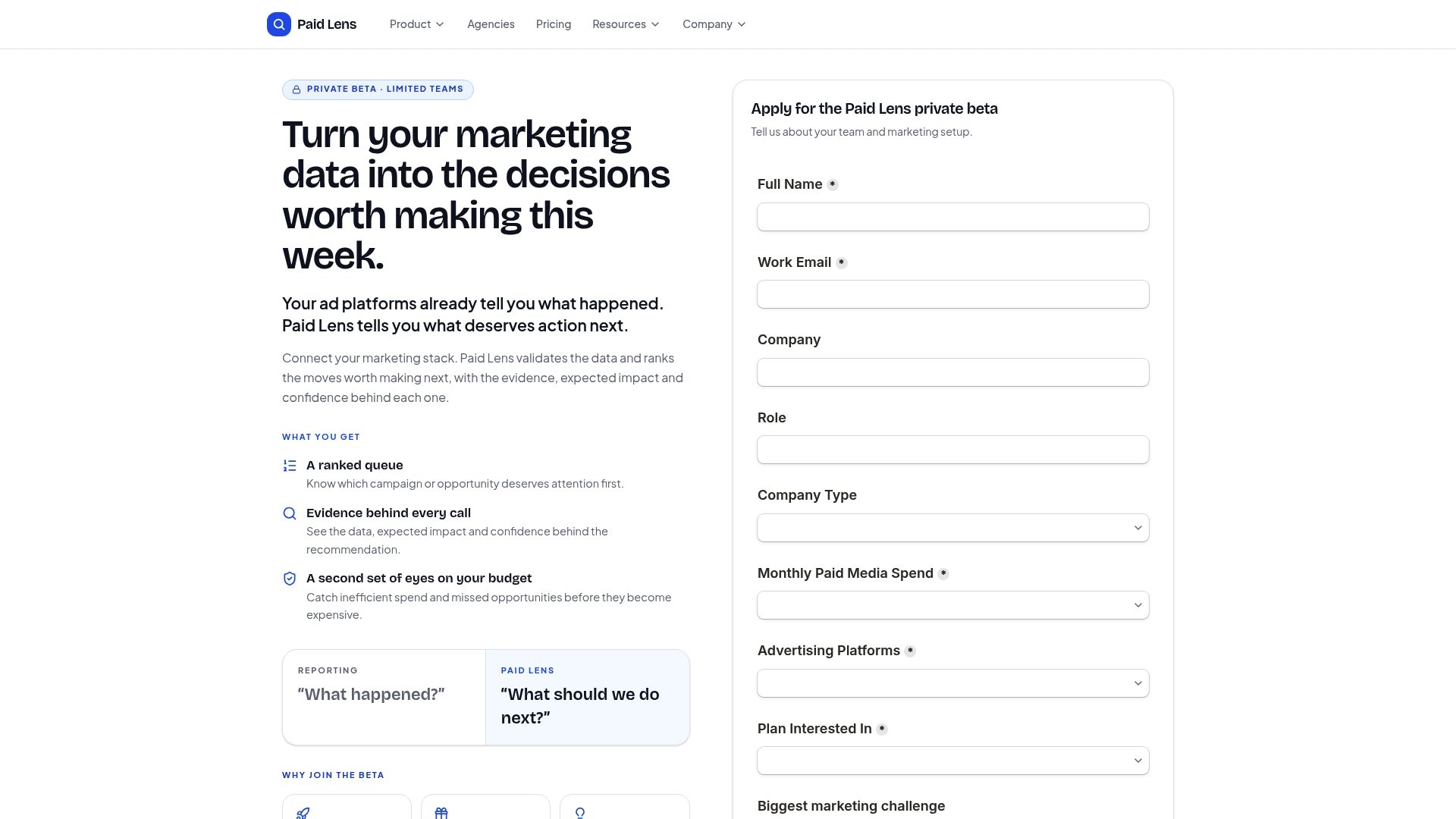
If your team is evaluating attribution that connects directly to your ad platforms and CRM data, Paid Lens validates data quality first, then tells you what to fix and why. Agencies managing multiple client accounts get portfolio-level visibility instead of switching between disconnected dashboards, and the integrations cover the ad platforms and revenue sources most teams already rely on.
A sensible pilot runs 30 days: connect your top three ad accounts, validate spend totals against your existing reporting, and review the first week of ranked recommendations against what your team would have decided manually. If the recommendations hold up, you have your answer. Start a Paid Lens trial and see the first ranked recommendation queue for your own accounts.
Sources
- Top 3 funnel.io Alternatives & Competitors
- 7 Best Funnel.io Alternatives in 2026: Real Reviews & Features
- Funnel.io Alternatives in 2026: 5 Options Evaluated by Execution Architecture, Not Feature Lists | Spike
- Supermetrics reviews on G2
FAQ
What Are the Best Alternatives to Funnel.io?
Paid Lens leads for teams that need ranked, actionable recommendations rather than raw dashboards. Supermetrics and Coupler.io suit spreadsheet-first teams, while Adverity and Domo fit enterprises needing governed transformation and scale.
Is Funnel Marketing Outdated?
No, but the tooling around it has shifted. Teams increasingly want platforms that recommend specific actions instead of just visualizing historical data, which is why decision-intelligence tools like Paid Lens have gained traction alongside traditional pipe-and-dashboard tools.
Is Funnel.io an ETL Tool?
Yes, functionally. Funnel.io extracts marketing data from ad platforms, transforms and normalizes it, and loads it into dashboards or downstream destinations, which places it closer to a managed ETL platform than a simple connector.
What Is the Best Sales Funnel Software?
That depends on whether you need data consolidation or actual campaign decisioning. For consolidating and reporting on funnel data, tools like Whatagraph or Adverity work well; for deciding what to change based on that data, Paid Lens is built specifically for that job.
Should I Choose a Pipe-Only Tool or a Managed Platform?
Choose a pipe-only tool like Supermetrics or Airbyte only if you have analyst or engineering capacity to handle transformation downstream. Choose a managed platform like Adverity, Improvado, or Paid Lens if you want normalization and analysis handled for you.