Prove AI Budget Optimization in 4–6 Weeks for Marketing & Finance
A FinOps aware playbook for marketing and finance teams to run two stage ML budget pilots, enforce spend caps, and prove lift in 4–6 weeks.

Prove AI Budget Optimization in 4–6 Weeks for Marketing & Finance
AI budget optimization reallocates existing marketing dollars toward the segments, channels, and audiences producing the highest marginal return, improving ROAS without necessarily spending more. The fastest path to proving it works is a constrained pilot: pair a payout prediction model with a budget optimizer, enforce hard caps on how much spend can shift, and measure the outcome against a holdout. Success means a validated lift in your primary KPI, not just a model that looks smart on paper.
TL;DR:
- Effective AI budget optimization requires a constrained pilot focusing on key channels, segments, and a primary KPI like ROAS to validate performance.
- The two-stage model separates outcome prediction from budget allocation, enabling easier adjustments and better governance over campaign reallocations.
- At least 90 days of clean historical data with multiple spend levels per segment are necessary to produce reliable payout predictions.
- Different algorithms suit various situations: greedy methods are quick but limited, Bayesian optimization handles noise better, and zero-shot models retain high performance with less compute.
- Building a full AI budget system from scratch demands significant engineering, so using pre-built solutions like Getpaidlens can accelerate deployment and provide auditable recommendations.
Table of Contents
- What Is AI Budget Optimization, and Why Does It Matter?
- How Does the Two-Stage AI Model Work?
- What Data Do You Need Before You Start?
- Which Algorithm Fits Your Budget Optimization Problem?
- How Do You Build and Scale an AI Budget Optimization Pilot?
- How Do You Govern AI-Driven Budget Decisions?
- The Paid Lens Approach to Auditable Budget Decisions
- Build vs. Buy: What Actually Determines Readiness
- Try Getpaidlens Before You Build the Full Stack
- Sources
- FAQ
What Is AI Budget Optimization, and Why Does It Matter?
AI budget optimization is the practice of using machine learning models to predict which combination of channels, campaigns, and audience segments will generate the most value per dollar, then automatically or semi automatically shifting spend toward those combinations. The business outcomes it targets are concrete: better ROAS, lower CPA, and a healthier LTV to CAC ratio.
The biggest gains show up in complex, multi-channel portfolios where a human analyst simply can’t hold every variable in their head at once. A team running Google, Meta, TikTok, and programmatic display across a dozen audience segments is managing more combinations than any spreadsheet can meaningfully rank. Gartner’s 2025 CMO survey found marketing budgets have flatlined relative to revenue, which is exactly why reallocation, not expansion, has become the primary lever for growth.
That said, the trade-offs are real:
- Optimization models can obscure why a recommendation was made, which erodes stakeholder trust.
- Platform-native “black box” tools often optimize for their own attribution, not your actual revenue.
- Aggressive reallocation without guardrails can destabilize campaign learning phases.
Transparency isn’t optional here. It’s the difference between a tool your finance team will approve and one they’ll quietly override.
How Does the Two-Stage AI Model Work?
Most credible systems for machine learning budget allocation split the problem into two distinct stages rather than asking one model to do everything. This separation is deliberate, and it’s the architecture Atlassian describes in detail from building its own ML optimization system.
- The payout model predicts the expected outcome (conversions, revenue, incremental value) for a given spend level in a given segment. It needs clean historical features: spend, conversions, seasonality, and audience signals, at minimum.
- The budget optimizer takes those predictions and searches for the allocation across all segments that maximizes the aggregate objective, subject to constraints like minimum spend per channel or maximum shift per cycle.
- The feedback loop feeds new performance data back into the payout model on a rolling basis, so predictions improve as market conditions shift.
Separating prediction from optimization matters for governance as much as accuracy. When the payout model is wrong, you can isolate and retrain it without touching the optimization logic. When the optimizer’s constraints need adjusting, finance can change a cap without retraining anything. Atlassian’s own experiments with this architecture produced double-digit efficiency gains across channels without increasing total spend, largely because the optimizer could see the whole portfolio at once instead of optimizing each channel in isolation.
Most teams run this as an offline batch process weekly or daily, with an online layer flagging anomalies in near real time. The batch cadence keeps compute costs sane; the real-time layer catches the failures that can’t wait a week.
What Data Do You Need Before You Start?
A payout model is only as good as what feeds it, and this is where most pilots quietly fail before they even launch. You need enough history and enough signal quality to trust a machine’s judgment over a human’s.
The essential inputs are:
- Spend history by channel, campaign, and segment, at daily granularity where possible
- Conversion and revenue data joined back to the campaign level, ideally through revenue attribution tied to your CRM
- Seasonality markers (holidays, promotions, product launches) so the model doesn’t mistake a seasonal spike for a channel breakthrough
- Platform-reported metrics for cross-checking, since Meta and Google will sometimes disagree with your CRM by a wide margin
Before trusting any model output, run a data quality pass: check that attribution windows match across platforms, that server-side tracking hasn’t quietly dropped events, and that naming conventions are consistent enough for automated joins to work without manual cleanup.
For a credible pilot, plan on at least 90 days of clean historical data across the channels you want to optimize, with at least a handful of distinct spend levels tested per segment. Less than that, and the payout model is mostly guessing.
Which Algorithm Fits Your Budget Optimization Problem?
There’s no single best method for machine learning budget allocation. The right choice depends on how much data you have, how fast conditions change, and how much compute you’re willing to spend on every reallocation cycle.
- Greedy and gradient-based methods are fast and cheap, incrementally shifting spend toward the highest marginal return segment. They work well when your response curves are smooth and well understood, but they can get stuck in local optima across complex, multi-constraint portfolios.
- Bayesian optimization handles noisy, expensive-to-evaluate objectives well, which suits marketing because every “experiment” costs real ad spend. It’s slower to converge but far more sample-efficient than brute-force search.
- Cross-Entropy (CE) methods iteratively sample and refine a distribution of good allocations, useful when the search space is large and non-convex. They need more compute than greedy approaches but tolerate messier reward signals.
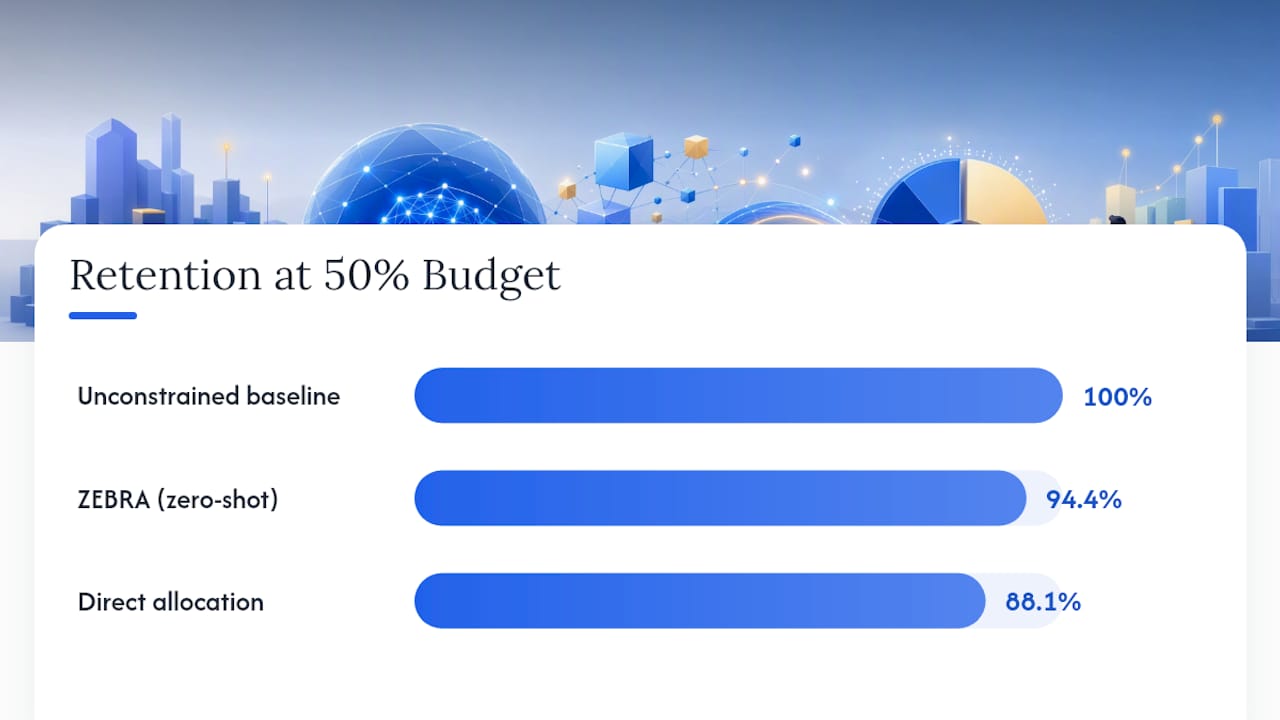
- Zero-shot frameworks like ZEBRA skip the expensive search entirely by estimating utility curves per segment upfront, then applying a water-filling solver to allocate the constrained budget. ZEBRA’s own benchmarks show it retaining 94.4% of unconstrained performance at 50% of budget, versus 88.1% for direct allocation methods, which matters most when you’re cutting budgets, not just optimizing them.
Pro Tip: Run a second, independent optimizer on the same inputs as a validator. If the two disagree by a wide margin on where budget should go, that’s a signal your payout model has a blind spot, not that one optimizer is smarter than the other.
Data and compute requirements scale roughly with sophistication: greedy methods run on a laptop, CE methods want a proper compute cluster, and zero-shot approaches trade upfront modeling effort for near-instant inference-time decisions.
How Do You Build and Scale an AI Budget Optimization Pilot?
A pilot succeeds or fails on how tightly you scope it. Trying to optimize every channel and every KPI on day one is the single most common way teams sink a promising project.
- Define the pilot scope. Pick two or three channels, a handful of segments, and a fixed budget envelope you’re willing to reallocate within. Choose one primary KPI, ROAS, incremental ROAS, or blended CAC, and stick to it.
- Design the experiment. Hold out a control group of campaigns that keep their existing allocation. Run pre and post comparisons against that holdout for at least four to six weeks, long enough to smooth out day-of-week and platform learning-phase noise.
- Set operational controls before launch. Cap any single reallocation cycle at a fixed shift limit, engineering teams commonly use limited percentage shifts of baseline per refresh to avoid destabilizing algorithms, as Grammarly’s engineering team documented, to avoid destabilizing platform learning algorithms. Add a human approval gate for any recommendation above that threshold.
- Set scaling criteria in advance. Decide the minimum uplift over the control group, alongside stability across at least two full refresh cycles, that would justify rolling the model out to more channels.
The reallocation cap deserves attention on its own. Ad platforms like Google and Meta rely on stable spend signals to keep their own machine learning models calibrated; a violent swing in daily budget can reset a campaign’s learning phase and tank performance for days, which is the opposite of what you’re trying to achieve.
How Do You Govern AI-Driven Budget Decisions?
Governance is where most AI budget optimization projects either earn finance’s trust or lose it permanently. The distinction that matters most: budgets are strategic targets you’re aiming for, while hard caps are enforced ceilings the system cannot cross, no matter how confident the model is. Inference lays out four levers that apply just as cleanly to marketing spend as to AI compute costs.
- Visibility first. You can’t govern spend you can’t see in near real time, by channel, segment, or campaign.
- Budgets and hard caps together. A budget is a target; a cap actually stops spend from crossing a line.
- Anomaly detection with automated stops. A model recommending a 400% spend increase overnight should trigger a pause, not an auto-execute.
- Smart routing. When performance is comparable, route budget toward the cheaper channel or placement rather than the more expensive one that offers no measurable edge.
Pro Tip: Put cost-to-value review on a recurring calendar, monthly at minimum, rather than treating it as a one-time launch task. Bain’s FinOps for AI framework frames this as an ongoing capability, not a project with an end date, and that framing is exactly right for marketing budgets too.
The Paid Lens Approach to Auditable Budget Decisions
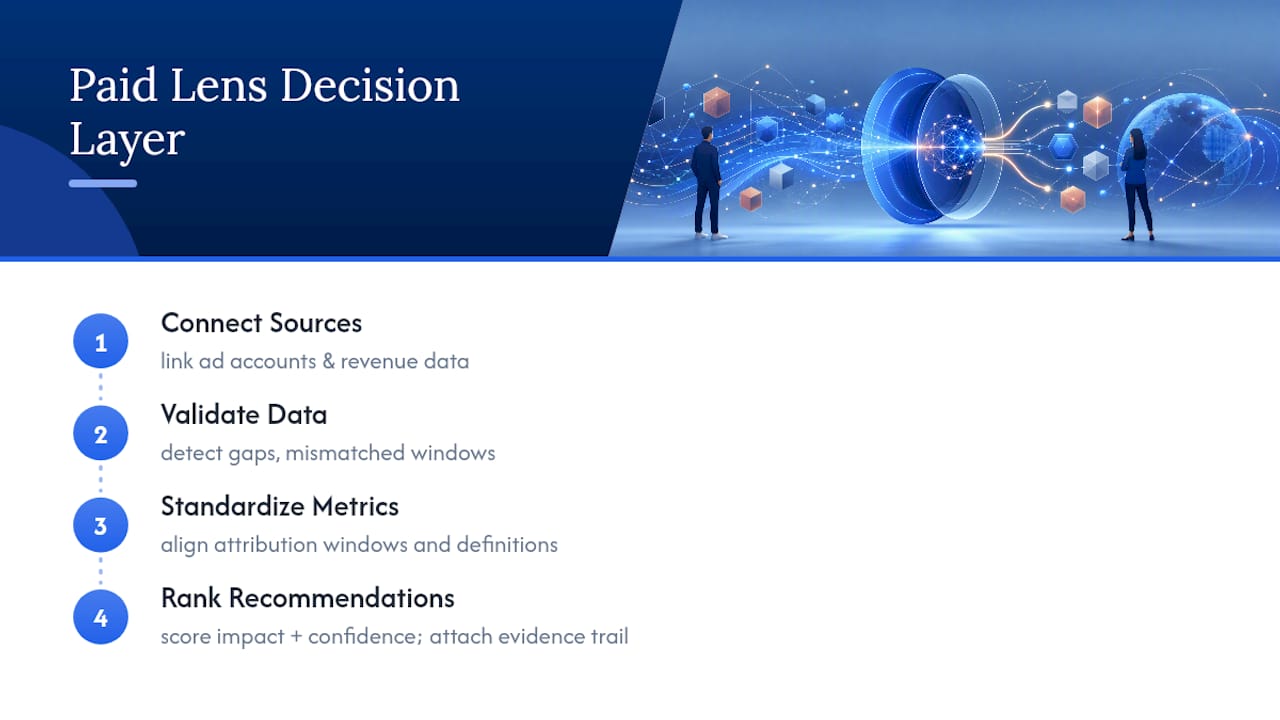
This approach can be operationalized as a decision layer that sits on top of existing ad platforms and revenue data, connecting ad accounts, validating data quality, and standardizing metrics to prevent the payout model from working with mismatched attribution windows.
Instead of a black box recommendation, such a solution can rank suggested budget moves by expected business impact and a confidence score, so teams spend their limited attention on the highest-value decisions first. Every recommendation carries an evidence trail, which helps build trust with finance stakeholders.
Build vs. Buy: What Actually Determines Readiness
The build versus buy decision usually comes down to whether you already have ML engineering and FinOps capacity sitting idle, most teams don’t. Buying a decision layer gets you to a validated pilot in weeks instead of quarters.
What you do need internally, regardless of path: someone who owns data quality, someone accountable for the incremental ROAS measurement, and a monthly governance habit. Start there before you touch a model.
— Shraddha
Try Getpaidlens Before You Build the Full Stack
Building a payout model, an optimizer, and a governance layer from scratch takes a data science team, months of engineering time, and ongoing FinOps overhead most marketing teams don’t have budget for. Such a decision layer can be provided as a pre-built solution, connected to existing ad accounts and revenue data, offering ranked recommendations and confidence scores instead of a black box.
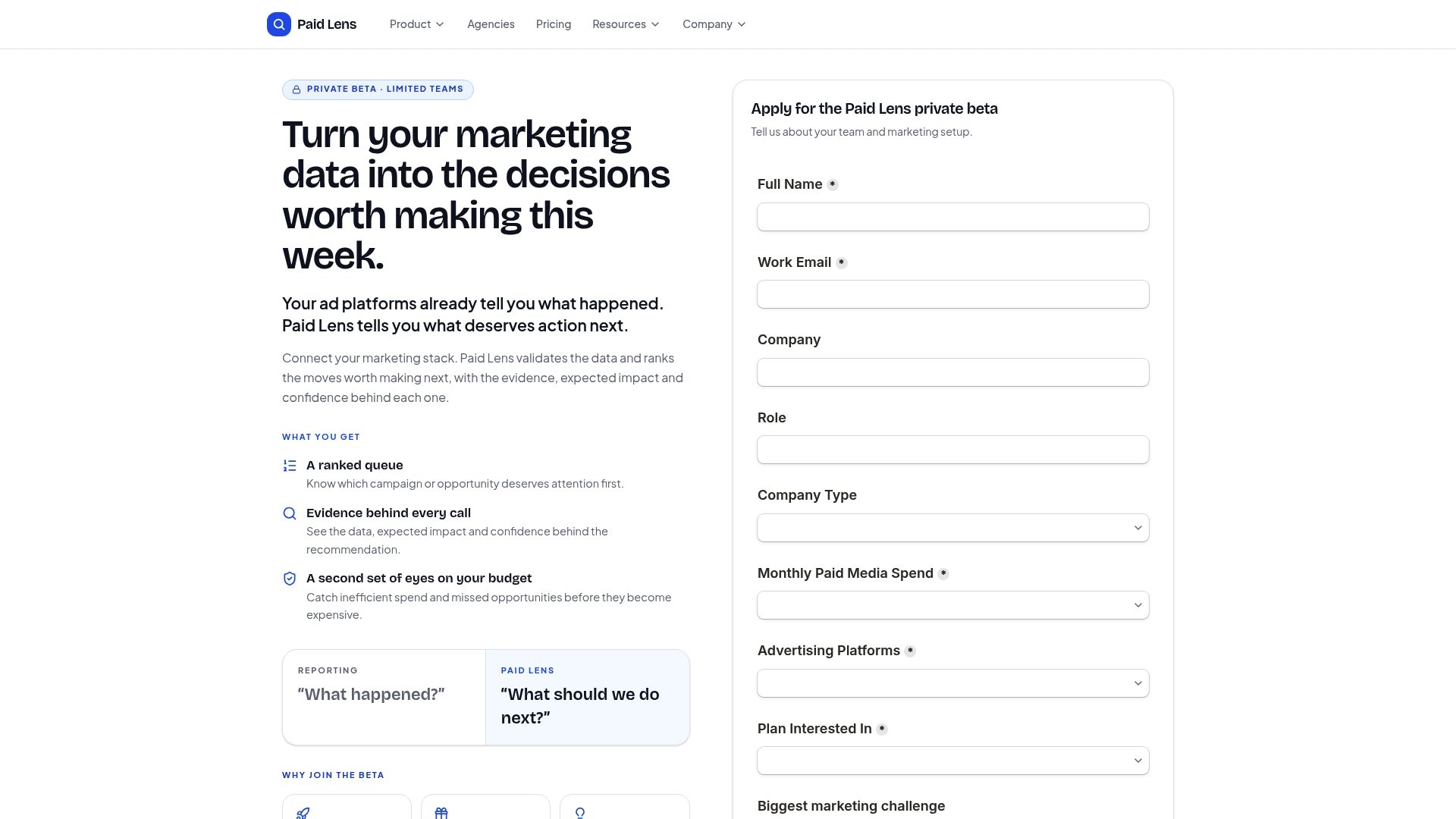
It works by linking your ad platforms and CRM through Getpaidlens’s connections, validating the data automatically, and surfacing an auditable trail behind every suggested move through its attribution and audit capabilities. Teams also managing AI agents across other functions, like Orphora AI’s voice agents for e-commerce, are seeing similar demand for auditable, explainable automation rather than opaque autopilot.
This type of solution fits performance marketing teams and agencies managing multiple client accounts and real budget stakes, rather than solo advertisers running one small campaign. Users start by connecting their accounts and reviewing a ranked recommendation queue.
Sources
- LLM Cost Optimization: How to Control AI Spend (2026)
- Budget allocation at scale: building an ML optimization system (Atlassian)
FAQ
Is There an AI That Helps With Budgeting?
Yes. AI tools exist for both personal budgeting and enterprise marketing budget optimization; the latter relies on machine learning financial planning models like payout predictors and constrained optimizers, which is the category Getpaidlens operates in for performance marketing teams.
What Is the 50/30/20 Rule for a Budget?
The 50/30/20 rule is a personal finance guideline allocating 50% of income to needs, 30% to wants, and 20% to savings; it’s a household budgeting heuristic, not a marketing spend framework.
What Is the 70/20/10 Rule for Marketing Budget?
It’s a common allocation heuristic where 70% of budget goes to proven, high-performing channels, 20% to channels showing promise, and 10% to experimental bets, giving a portfolio some room to test without risking the core budget.
Which AI Is Best for Preparing Budgets?
There’s no single best tool. For enterprise performance marketing, the strongest results come from systems using a two-stage payout model and optimizer with enforced governance, the same architecture behind Getpaidlens’s ranked recommendations, rather than a generic AI assistant asked to guess at allocations.