ROAS Optimization: A Framework That Actually Moves Numbers
Unlock higher revenue with effective ROAS optimization strategies. Start improving your ad spend efficiency today with actionable insights.

ROAS Optimization: A Framework That Actually Moves Numbers
ROAS optimization means systematically increasing the revenue you generate per dollar of ad spend, and it starts with math, not bidding tricks. The formula is simple: ROAS = revenue ÷ ad spend.
Here’s the claim that gets skipped in most guides: before you touch a bid strategy or write a new headline, verify that your measurement is accurate and your post-click experience actually converts. A campaign with broken tracking or a slow landing page will make every other optimization look worse than it is, or better than it deserves.
Your first move, today, should be one of these two:
- Run a measurement check. Confirm conversion tracking fires correctly, attribution windows match across platforms, and no duplicate events are inflating results.
- Do a stop-the-bleed pass. Pull the last 30 days of spend by placement and audience, and cut anything burning budget with zero conversions.
Statistic to know: platforms typically want 30 to 100 conversions per month before their bidding algorithms have enough signal to perform well. If you’re below that, no bidding switch will save you. Fix the fundamentals first.
Key Takeaways
Effective ROAS optimization requires accurate measurement and a converting landing page before any bid strategy change can produce reliable, lasting results.
| Point | Details |
|---|---|
| Fix measurement first | Verify tracking and attribution windows before changing bids or budgets. |
| Calculate break-even ROAS | Use 1 ÷ (gross margin % − variable cost %) to find your real profitability floor. |
| Follow the five-layer order | Optimize audience, creative, landing page, offer, then bids, in that sequence. |
| Respect bidding thresholds | Wait for 30 to 100 monthly conversions before testing Target ROAS bidding. |
| Use Paid Lens for prioritization | Its ranked, confidence-scored recommendations show which fix to make first across connected ad platforms. |
Table of Contents
- How to Calculate ROAS and Set Realistic Targets
- The Five-Layer Framework for Improving ROAS
- Tactical Playbook: Exclusions, Creative Tests, and Offer Tweaks
- Measurement and Attribution: Can You Trust Your Numbers?
- Choosing Between Target ROAS, Maximize Conversion Value, and Manual Bids
- Your Weekly ROAS Audit Checklist
- How Paid Lens Puts This Framework Into Practice
- What the Data Actually Supports
- Get a Ranked Queue Instead of a Guessing Game
- Sources
- FAQ
How to Calculate ROAS and Set Realistic Targets
The basic formula rarely causes confusion: divide revenue by ad spend. Spend $5,000, generate $22,500, and your ROAS is 4.5.
That’s where break-even ROAS comes in. It tells you the minimum return needed just to cover costs, before a campaign contributes any actual profit.
Break-even ROAS = 1 ÷ (gross margin % − variable cost %)
Your break-even ROAS is 1 ÷ 0.30, or roughly 3.33. Anything below that is losing money even though the campaign “worked” on paper.
Converting that into channel-specific targets takes a few steps:
- Calculate break-even ROAS for each product line or margin tier separately, since bundles and discounted SKUs shift the math significantly.
- Layer in customer lifetime value. A $50 first purchase that leads to $400 in repeat revenue over a year justifies a much lower first-touch ROAS than a one-time transaction product.
- Set funnel-stage targets. Prospecting campaigns feeding top-of-funnel awareness should carry lower ROAS thresholds than retargeting campaigns closing warm leads.
- Adjust for channel cost structure. A channel with lower CPMs but weaker intent (like some social placements) may need a higher ROAS floor than a high-intent search campaign to hit the same profit outcome.
The Five-Layer Framework for Improving ROAS
Most ROAS problems don’t come from one broken thing. They come from small inefficiencies stacked across five layers: audience, creative, landing page, offer, and bid strategy. Fix them in that order, and each layer’s gains compound instead of getting undone by the next bottleneck.
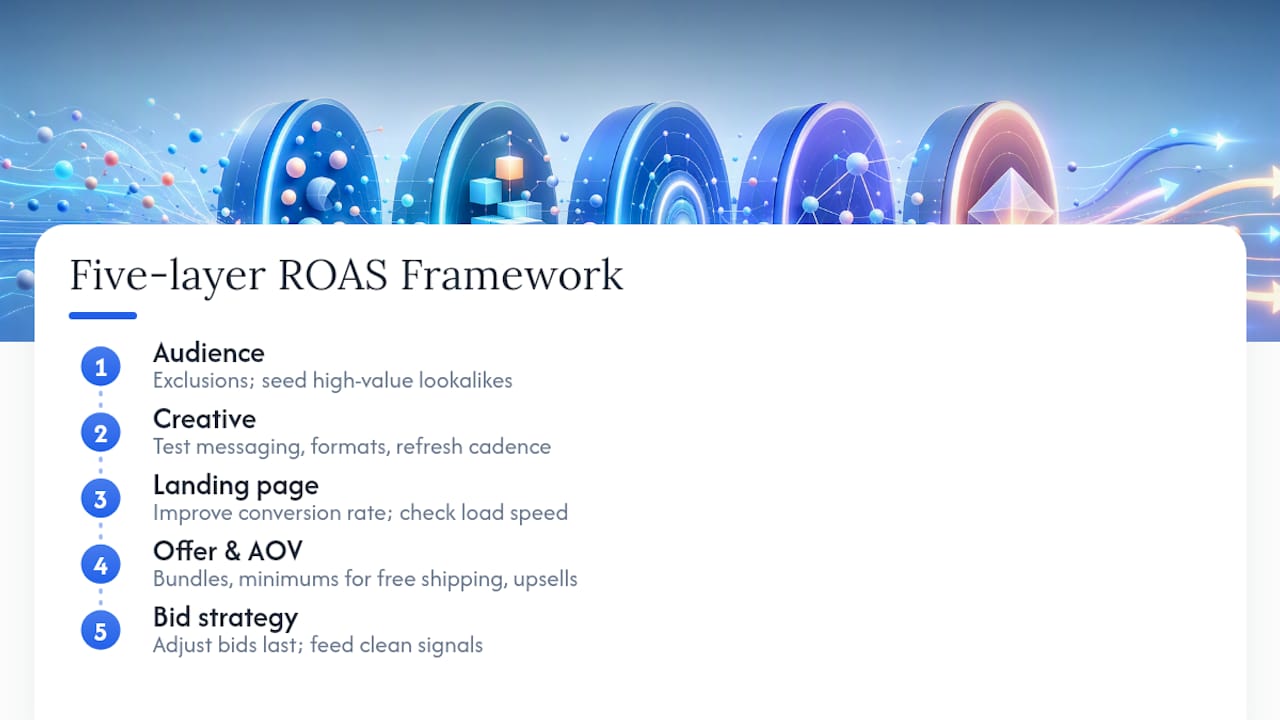
Audience comes first because no amount of creative brilliance saves a campaign showing ads to the wrong people. This means building exclusion lists, seeding lookalikes from your highest-value customers rather than all past purchasers, and cutting placements that generate clicks without conversions.
Creative comes second. Once the audience is right, the ad itself has to earn attention and clicks. This is where message testing, format variation (video versus static versus carousel), and refresh cadence live.
Landing page is the layer most teams underinvest in, which is a mistake. Fixing the landing page tends to produce more durable gains than audience or bid tweaks because a conversion-rate improvement holds steady over time, while auction dynamics and CPCs shift constantly.
Offer and average order value come fourth. Bundling, minimum-order thresholds for free shipping, and post-purchase upsells change the revenue side of the ROAS equation without touching spend at all.
Bid strategy and budget allocation come last, deliberately. Bidding algorithms optimize toward whatever signal you feed them. Feed them a clean audience, strong creative, a converting landing page, and a solid offer, and the algorithm has something worth optimizing. Feed it garbage, and it just finds efficient ways to spend on garbage faster.
That’s why systematic work across every lever, rather than chasing one big win, tends to outperform teams obsessed with a single tactic.
Pro Tip: When ROAS drops suddenly, check landing page load speed and tracking integrity before you touch bids or budgets. A tracking break or a page that stopped loading on mobile will masquerade as a targeting problem every time.
When ROAS drops and you need to prioritize, work backward through the layers: check measurement first, then post-click experience, then creative fatigue, then audience waste, and only then consider a bid strategy change.
Tactical Playbook: Exclusions, Creative Tests, and Offer Tweaks
This is where strategy becomes weekly work. The highest-leverage tactics fall into four buckets, and you don’t need all four running simultaneously to see movement.
Negative keywords and placement exclusions are the fastest lever to pull because the work is mechanical. Pull a search terms report weekly for the first month of any campaign, then monthly after that. Flag anything irrelevant, anything converting below break-even ROAS, and any placement (app category, YouTube channel, publisher site) generating impressions without a single conversion. Waste from irrelevant audiences or placements can run 20 to 40% of budget in unmanaged accounts, which makes this the single highest-return hour you can spend each week.

Creative testing should follow a concept, format, execution order. Test broad creative concepts against each other first (a problem-solution angle versus a social-proof angle), then test formats within the winning concept (video versus static), then refine execution (copy, thumbnail, CTA button color) within the winning format. Use a stopping rule of roughly 50 conversions per variant before declaring a winner. Fewer than that, and you’re reading noise as signal.
Creative fatigue is real and predictable. On Meta, performance typically softens within 14 to 21 days as frequency climbs and the same audience sees the same ad too many times. Build a refresh calendar around that window rather than waiting for performance to visibly decline.
Landing page fixes with the fastest payback:
- Message match. The headline on the landing page should mirror the ad’s exact promise, not a general version of it.
- Page speed. Since mobile accounts for the majority of web traffic, a slow-loading mobile page taxes every campaign pointing to it. Target sub-2.5 second Largest Contentful Paint.
- Trust signals above the fold. Reviews, security badges, and clear return policies reduce hesitation at the exact moment someone decides whether to convert.
Offer mechanics move average order value without touching spend: a “spend $50, get free shipping” threshold, a post-purchase upsell at checkout, or a simple two-item bundle discount. These changes often lift AOV by a meaningful margin within a single test cycle, directly improving ROAS even if conversion rate and traffic stay flat.
A realistic four-week test might run negative keyword cleanup in week one, launch a creative concept test in week two, ship a landing page speed fix in week three, and test a bundle offer in week four; stack the wins and you often see a blended ROAS lift in the double digits by the end of the month.
Measurement and Attribution: Can You Trust Your Numbers?
Every optimization built on this article’s framework assumes your ROAS number is real. Often it isn’t, and the gap comes from a handful of recurring measurement problems.
Inconsistent attribution windows top the list. If Google Ads reports on a 30-day click window while your platform’s dashboard uses 7-day click plus 1-day view, you’ll see two different ROAS figures for the same spend, and neither is wrong exactly, they’re just not comparable. Pick one attribution window standard and apply it everywhere you report ROAS internally.
Duplicate events inflate conversions when both a client-side pixel and a server-side event fire for the same purchase without deduplication. This artificially boosts ROAS on paper while doing nothing for actual revenue.
Missing server-side events happen as browser tracking degrades from ad blockers, cookie restrictions, and iOS privacy changes. The fix is implementing server-side tracking, such as a Conversions API integration, that captures purchase events directly from your server rather than relying solely on browser-based pixels.
- Standardize attribution windows across every platform before comparing ROAS between them.
- Deduplicate events between client-side and server-side tracking.
- Layer in blended ROAS (total revenue divided by total spend across all channels) as a sanity check against platform-reported numbers, which tend to over-claim credit individually.
- Where budget allows, run incrementality tests using holdout or geographic splits, which measure actual causation rather than correlation between ad exposure and purchase.
Pro Tip: Before you compare test results across two campaigns or two time periods, confirm both are using identical attribution windows. A “winning” variant can simply be the one measured on a longer window, not the one that actually performed better.
Consistent attribution windows matter most when you’re running any kind of A/B test. Comparing a 7-day window result against a 30-day window result will hand a false victory to whichever campaign had more time to accumulate credit, regardless of which one actually drove more incremental revenue.
Choosing Between Target ROAS, Maximize Conversion Value, and Manual Bids
Bid strategy sits at the top of the framework for a reason: it should be the last thing you adjust, not the first. Platforms are explicit about why. Google recommends roughly 30 to 100 conversions per month before switching a campaign to Target ROAS bidding, because the algorithm needs enough conversion signal to model outcomes reliably. Flip the switch too early, and you get erratic, unpredictable spend instead of the stability you were hoping for.
The two most common algorithmic strategies behave differently, and mixing them up causes real budget pain:
- Target ROAS optimizes toward a specific return target you set, giving you control over ROI at the cost of potentially limiting volume if the target is aggressive.
- Maximize conversion value, by contrast, optimizes purely for conversion value and can spend up to your full daily budget pursuing that goal, with no built-in ROI ceiling unless you layer a target on top of it.
A safe staging sequence looks like this:
- Start with manual or enhanced CPC bidding while the campaign accumulates conversion history.
- Reach the minimum conversion threshold before considering any switch to algorithmic bidding.
- Test Target ROAS with a conservative target close to your current actual performance, not an aspirational number.
- Limit daily budget changes to 20% or less, or use phased increases in the 15 to 20% range, whenever you scale spend on an already-stable campaign.
That last rule matters more than most teams realize. Some platforms report meaningful conversion value uplifts from AI-driven bidding features, but those gains only materialize when measurement and setup are correct going in. Skip the staging, and you’re just adding automation on top of a broken foundation.
Your Weekly ROAS Audit Checklist
Optimization isn’t a one-time project. It’s a weekly habit, and the habit works best when it’s short enough to actually finish every week.
- Measurement check. Confirm tracking fired correctly and attribution windows are still consistent across platforms.
- Post-click check. Spot-check landing page load speed and conversion flow on both desktop and mobile.
- Waste pass. Review search terms, placements, and audiences for anything burning spend with zero conversions.
- Creative rotation. Check frequency and time-in-market on active creative; refresh anything approaching the 14 to 21 day fatigue window.
- Budget moves. Apply the 20%-or-less rule to any budget adjustment; log the change and the reason.
- Test log. Record what’s currently being tested, sample size so far, and expected read date.
Decision rules keep this from becoming a judgment call every time:
| Signal | Action |
|---|---|
| ROAS below break-even for 2+ weeks | Pause and rebuild targeting or creative |
| CTR dropping, frequency rising | Refresh creative immediately |
| CVR dropping, traffic steady | Audit landing page before touching bids |
| ROAS stable above target for 3+ weeks | Scale budget in capped increments |
Track CTR, conversion rate, average order value, and blended ROAS for every row on this checklist. A balanced allocation that keeps roughly 70% of budget on proven performers, 20% on scaling experiments, and 10% on genuinely new tests protects your baseline while still leaving room to find the next winning lever.
How Paid Lens Puts This Framework Into Practice
Everything in this framework, measurement hygiene, layered prioritization, staged bidding, depends on having clean, unified data across platforms. That’s the part most teams struggle with, and it’s the specific problem Paid Lens was built to solve.
Paid Lens connects your ad platforms, validates data quality before it reaches your dashboards, and turns standardized performance history into a ranked queue of recommended actions:
- Cross-platform data validation catches the duplicate events and tracking gaps that quietly distort ROAS.
- Recommendations come ranked by expected business impact and confidence score, not a generic alert feed.
- The attribution reporting is built to be audited, so you can see exactly why a recommendation was made.
- Suggested next actions on creative and budget map directly to the audience, creative, and bid layers of this framework.
The gap between knowing what to optimize and knowing what to optimize first is where most marketing teams lose time. A ranked, confidence-scored queue closes that gap instead of adding another dashboard to check.
Instead of manually running the weekly audit checklist above across five different platform interfaces, a team using Paid Lens gets that prioritization surfaced automatically, with the confidence score attached so you know which recommendation to act on today.
What the Data Actually Supports
The conventional advice on ROAS optimization treats bidding strategy as the lever, when it’s really the last domino. Every credible source on this topic, from platform documentation to independent optimization guides, points the same direction: fix measurement, fix the landing page, then worry about which automated bidding mode to pick.
Where I think most teams get it backward is urgency. Switching to Target ROAS feels like progress because it’s a visible, one-click change. Auditing your attribution windows feels tedious because the payoff is invisible until something breaks. But the tedious work is what makes the visible change actually work.
If you take one thing from this framework, prioritize the landing page over the ad account. Creative and audience tweaks fight the auction every day; a faster, better-converting page keeps paying off with zero ongoing effort. Do that first, get your conversion counts high enough for real bidding data, then let the algorithm work with signal worth having.
— Shraddha
Get a Ranked Queue Instead of a Guessing Game
Running the five-layer framework by hand across multiple ad accounts means pulling reports from each platform separately, reconciling attribution windows manually, and deciding what to fix first with incomplete visibility. Paid Lens replaces that manual reconciliation with one connected view: it validates data quality across your ad platforms, standardizes the metrics so ROAS numbers actually match, and ranks recommended fixes by expected impact and confidence score.
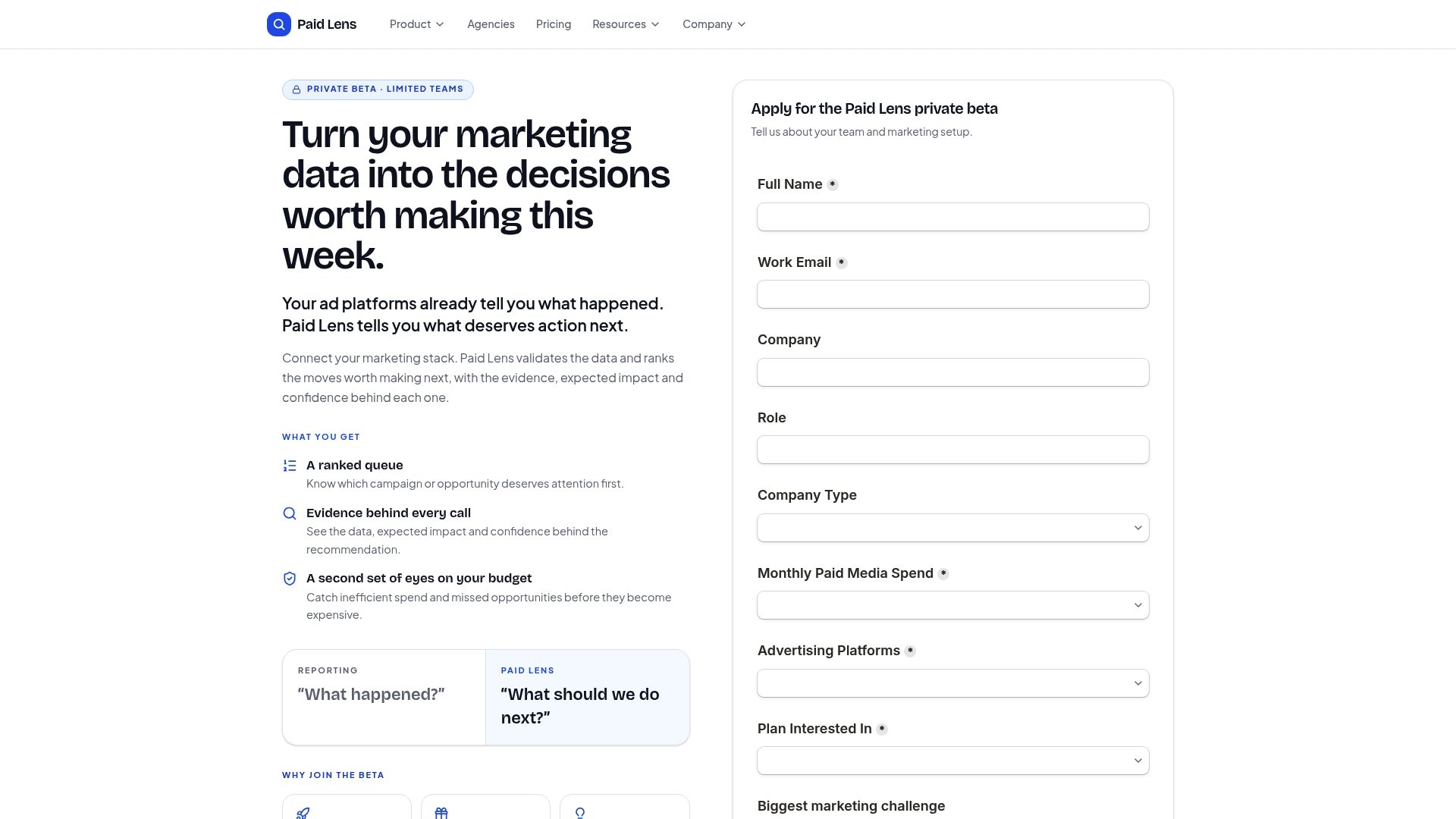
That’s the difference for a marketing team managing several channels and a real budget on the line: instead of building your own weekly audit spreadsheet, you get a prioritized action list generated from your actual account data, with the confidence level attached so you’re not guessing which fix matters most. Paid Lens also connects to CRM and revenue data sources, so recommendations account for downstream value, not just platform-reported conversions.
If accurate, auditable numbers are the foundation of everything in this article, start there. Check out the attribution reporting and see what a validated, ranked view of your own campaigns looks like.
Sources
- About Target ROAS bidding - Google Ads Help
- Share of website traffic coming from mobile devices - Statista
FAQ
What Is ROAS Optimization?
ROAS optimization is the systematic process of increasing revenue generated per dollar of ad spend, typically by fixing measurement accuracy, then improving audience targeting, creative, landing pages, offers, and finally bid strategy.
How Do You Optimize for ROAS?
Start by verifying your conversion tracking and attribution windows are accurate, then work through audience exclusions, creative testing, landing page conversion fixes, and offer changes before adjusting your bid strategy.
What Is a Good ROAS Target?
There’s no universal target. Calculate your break-even ROAS using 1 ÷ (gross margin % − variable cost %), then set targets above that number based on customer lifetime value and funnel stage.
How Many Conversions Do You Need Before Switching to Target ROAS?
Most platforms, including Google Ads, recommend roughly 30 to 100 conversions per month before switching to Target ROAS bidding so the algorithm has enough signal to perform reliably.
Can a Tool Like Paid Lens Help With ROAS Optimization?
Yes. Paid Lens connects your ad platforms, validates data quality, and ranks recommended optimizations by expected impact and confidence score, which speeds up the prioritization work this framework describes.